
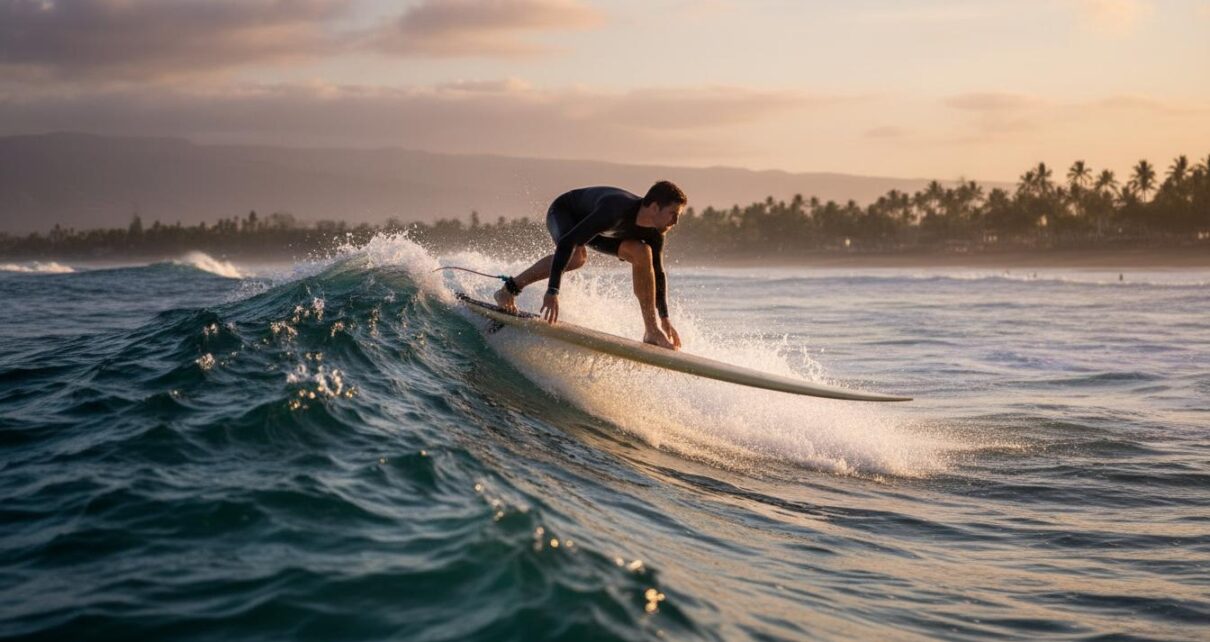
There’s a special hush when a longboard trims just right. The tail digs, the nose lifts, and five toes tip over the edge like a gull testing the wind. That moment has a name: hangfive. It’s stylish, practical, and well within reach on New Zealand’s mellow points and beachies when the banks line up.
This guide breaks down what hangfive means, how it works, the different styles you’ll see, and how to learn it without wasting seasons. You’ll also find local tips—where in Aotearoa it clicks, which boards help most, and how to avoid the usual wipeouts.
What is
Hangfive is a longboarding manoeuvre where the surfer walks to the nose and places the front foot so that five toes hang over the rail. The back foot stays on the board for balance. It’s a form of noseriding, different from hang ten, where both feet reach the nose.
In practice, hangfive rewards clean lines, timing, and small adjustments. On the right wave, it glides rather than feels forced. New Zealand’s long, bending walls—Raglan on a friendly day, Sandy Bay with a light offshore—are perfect training grounds.
How it works
The physics are simple but demanding. The tail must hold while the nose wants to dive. Your fin, rails, and the pocket of the wave create lift and drag that balance each other. When you shift weight forward, the tail sinks, the fin bites, and the nose stays clear.
Key ingredients:
- Trim speed: You need just enough speed to stay high on the face, not racing down the line.
- Pocket pressure: The board sits near the breaking part of the wave, where lift supports the nose.
- Rail engagement: Soft, fuller rails and a square or rounded tail help the board lock in.
- Fin hold: A larger single fin creates drag and directional stability that counters your forward weight.
On Kiwi waves, look for 0.6–1.2 m (2–4 ft) peelers with tidy faces. A light offshore, mid-tide, and a forgiving bank beat wind-swept closeouts every time.
Types / examples
Common hangfive variations
- Classic hangfive: Upright stance, front foot on the tip, relaxed back foot trailing behind the stringer.
- Cheater five: A low crouch with the back foot further forward to stabilise in weaker sections.
- Hangfive to hang ten: Step from five to both feet over the nose when the pocket fattens.
- Switch-foot hangfive: Same move with stance reversed, usually by advanced riders on long, predictable walls.
- Hangfive out of a drop-knee cutback: Redirect in the curl and step straight to the nose as the board re-engages.
Where it shines in Aotearoa
- Manu Bay, Raglan: Long, bending sections that hold a line. Go early before the crowd.
- Sandy Bay, Northland: Friendly walls on small swells with light winds.
- Mount Maunganui town beaches: Bank-dependent, but dreamy on knee-to-waist-high peelers.
- Mangawhai Heads and Omaha: Clean banks after a sand reset can be gold.
- Sumner and St Clair (Ōtautahi/Dunedin): Smaller south swells with a light northerly suit noseriding days.
- Lyall Bay, Wellington: Best on the inside banks on tiny, tidy days with offshore northerlies.
Comparing classic footwork moves
| Move | Toes over | Stability | Difficulty | Best board | Ideal conditions |
|---|---|---|---|---|---|
| Hangfive | Five | Moderate | Intermediate | Traditional log (9’0–9’6), single fin | 2–4 ft, clean, peeling pocket |
| Hang ten | Ten | Lower | Advanced | Classic log with wide nose, low rocker | Waist-high, slow, steady walls |
| Cheater five | Five (crouched) | Higher | Beginner to intermediate | Performance longboard or log | Smaller or weaker waves |
| Cross-step (no toes over) | None | High | Beginner to intermediate | Any longboard | Any clean longboardable wave |
| Full noseride (no specified toes) | 0–10 | Varies | Intermediate+ | Log with 50/50 rails | Clean pocket with push |
Pros and cons
Pros
- Style and flow: Hangfive adds character to otherwise simple lines.
- Wave control: Learning it sharpens trim, positioning, and pocket reading.
- Low impact: Less strain on knees and shoulders than aggressive shortboarding.
- Versatile: Works on many NZ breaks when the swell drops.
- Progression path: Leads naturally to hang ten and linked noserides.
Cons
- Board dependent: A true log makes it far easier than a shortboard or fish.
- Section sensitive: Steep, fast beach breaks shut it down fast.
- Crowd pressure: Close quarters make walking the board risky.
- Time on task: Cross-stepping takes reps before it feels natural.
How to use or choose
Step-by-step: how to learn hangfive
- Find the right day: 2–3 ft, clean, slow-peeling waves with a gentle pocket.
- Set your trim: Angle into the wave, fade slightly, and settle mid-to-high on the face.
- Lock the tail: Shift weight slightly back to engage the fin before you walk.
- Cross-step forward: Smooth, quiet steps along the stringer—no shuffling.
- Enter the pocket: Aim for the zone just ahead of the whitewater where the lift is strongest.
- Place the front foot: Ball of the foot on the nose with five toes curling over the rail.
- Stay light: Knees soft, shoulders over the stringer, eyes down the line.
- Micro-corrections: Subtle ankle rolls to steer; avoid big arm swings.
- Exit cleanly: Step back before the section hollows or the nose pearls.
- Link it up: Re-enter the pocket and repeat, building to longer holds.
Choosing the right board and setup
- Length and volume: 9’0–9’6 works for most riders; heavier surfers may enjoy 9’8–10’0.
- Rocker: Low to moderate nose rocker for glide; too much rocker kills speed.
- Rails: 50/50 or soft rails help the board hold in the pocket.
- Outline: Wider nose for stability; square or rounded square tail for hold.
- Fin: Single fin, 9–10 inches. A classic D fin offers hold; a flex fin adds release.
- Fin placement: Start 1–2 cm forward of the box centre. Move back for more hold, forward for looseness.
- Deck traction: Good wax or a nose concave and deck patch to prevent slips.
Conditions and locations in NZ that suit hangfive
- Northland to Bay of Plenty: Summer and early autumn mornings with light offshores.
- West Coast Waikato: Smaller days at Raglan when the banks are groomed and the crowd is patient.
- East Coast Auckland and Northland beachies: Post-storm sand resets can deliver gentle pockets.
- Canterbury and Otago: Small south swells with northerly winds; dress warm and pick inside banks.
Safety and etiquette
- Look before you walk: Don’t step forward if someone is paddling in front of you.
- Share the sets: Longboards catch waves early—don’t hog every ripple.
- Trim over tricks: If the pocket shifts, back out of the hangfive rather than forcing it.
- Gear check: Use a reliable leash and keep fins sharp but safe. Avoid crowded swim areas.
FAQ
What’s the difference between hangfive and hang ten?
Hangfive uses one front foot on the nose with five toes over. Hang ten places both feet on the nose and needs more pocket support and control.
Can I do hangfive on a mid-length or soft-top?
Yes, in forgiving conditions. It’s easier on a true log with a big single fin, but a stable mid-length with a 2+1 setup can work on small, clean days.
What wave size is best for learning?
Waist- to chest-high (around 2–4 ft) with a slow, peeling face. Avoid steep closeouts and strong onshores.
How long does it take to learn?
With regular surfs on the right days, many riders feel a short, stable hangfive within a few weeks. Longer holds take months of practice.
Where in New Zealand is hangfive most achievable?
Raglan’s longer walls, Northland points and beachies like Sandy Bay, mellow days at the Mount, and small clean sessions in Canterbury and Otago.
Which fins work best?
A 9–10 inch single fin. D fins give strong hold in the pocket; flex fins add spring and control on the way out.
Why does the nose pearl when I step forward?
You’re either too low on the face, too far ahead of the pocket, or moving too fast down the line. Climb higher, slow slightly, and engage the tail before stepping.
Is cross-stepping mandatory?
It’s the safest and smoothest way to move forward. Shuffling destabilises the board and makes pearling likely.
What wetsuit do I need in NZ?
North Island summers: 2/2 or 3/2. Winters: 4/3. South Island often needs 4/3 or 5/4 with booties. Staying warm keeps your footwork precise.
Can hangfive help my overall surfing?
Absolutely. It teaches trim, timing, and reading the pocket—skills that flow into every board and turn you make.
Final pointers
Keep it simple: pick mellow days, set your trim, and walk with intent. The best hangfive feels unhurried. When in doubt, step back, reset, and try again on the next section.
New Zealand serves up plenty of days built for this move. Pack the log, watch the wind, and give those five toes their moment in the light.


